Introduction
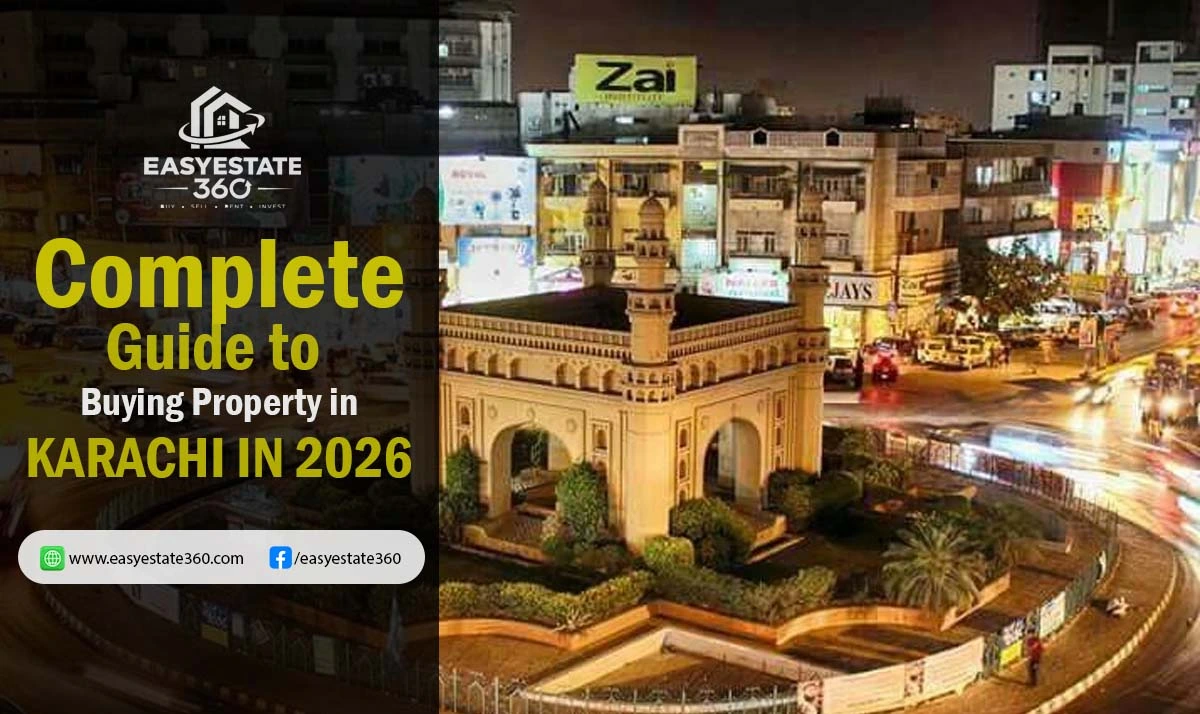
Buying property in Karachi is one of the most significant financial decisions you will ever make. It is also one of the most legally complex real estate markets in Pakistan. Karachi’s land jurisdiction is fragmented across multiple authorities—KDA, MDA, LDA, various Cantonment Boards, and the Sindh Revenue Board—and common fraud schemes include forged powers of attorney, multiple sales of the same plot, and hidden inheritance disputes.
In 2026, Karachi’s property market continues to grow. Average house prices across the city stand at approximately PKR 9.11 Crore, representing a 16% year-on-year increase. Meanwhile, the government has significantly reduced property transaction taxes through the Finance Act 2026-27, making it a favorable window for buyers.
This guide walks you through the complete process of buying property in Karachi in 2026, covering legal verification, tax obligations, SBCA requirements, and financing options.
Understanding Karachi’s Property Title System
Before you look at a single property, you must understand one fundamental truth about Pakistani real estate: There is no government-guaranteed certificate of title for immovable property. Both mutation (Intiqal) and registration of a sale deed are not conclusive title documents in themselves.
Karachi operates under an instrument-based registration system. The Fard-e-Malkiat (Record of Rights) and mutation records are presumptive evidence only—they show who is responsible for paying land revenue, not necessarily who holds absolute ownership rights. The Sindh High Court has consistently held that a sale agreement does not confer any right, title, or ownership in immovable property until a valid sale deed is executed and registered.
Bottom line: You—the buyer—must independently verify the entire chain of ownership before any money changes hands.
Step 1: Verify Ownership Through Fard-e-Malkiat
The Fard-e-Malkiat is the foundational document confirming recorded ownership. Obtain it from the Sindh Revenue Board or the relevant land records office.
What to verify:
The seller’s name matches their CNIC
No conflicting entries exist on the record
The property is not subject to any stay order or unresolved dispute
Important: The Fard is presumptive evidence, not a title guarantee. It must be cross-checked against registry deeds, mutation records, and litigation searches.
Step 2: Trace the Chain of Ownership
If the property has changed hands before, trace the chain of ownership through registry deeds at the Sub-Registrar’s office and mutation (Intiqal) records at the Land Revenue Office.
Every transfer must be properly recorded. Any break, gap, or inconsistency in the chain is a serious red flag. An unregistered deed or missing mutation could mean the seller does not have valid title to transfer.
Step 3: Obtain a Non-Encumbrance Certificate and Conduct Litigation Search
A Non-Encumbrance Certificate (NEC) confirms the property is free from mortgages, loans, or registered legal claims. This is especially critical if the seller has previously used the property as collateral.
You must also:
Check whether the property is subject to any ongoing court case—inheritance disputes, boundary disagreements, or fraud allegations
Confirm no court-issued stay order restricts sale or transfer
Have a property lawyer conduct a litigation search at relevant civil courts in Karachi
Step 4: Verify Power of Attorney (If Applicable)
Forged or expired powers of attorney are among the most common fraud schemes in Karachi. Under Pakistani law, a power of attorney automatically expires upon the death of the principal.
Critical steps:
Verify the POA directly with the Sub-Registrar’s office that issued it
Confirm it has not been revoked
Confirm the principal is still alive
Ensure the POA specifically authorizes sale of the property in question
Warning: If the seller is acting as a legal representative, ensure the power of attorney is valid and covers all necessary powers.
Step 5: Check Inheritance and Legal Heir Issues
Many Karachi property disputes are fundamentally family inheritance disputes. If the property involves a deceased owner, you must confirm:
All legal heirs under Sharia shares have been properly identified
Their rights have been formally documented through Letters of Administration (for immovable property) or Succession Certificate (for movable property)
Any one heir cannot sell on behalf of all heirs without explicit authorization
Special caution: Pakistani courts have consistently shown particular scrutiny toward cases where female heirs (daughters, sisters) have been improperly excluded from inheritance records. If the inheritance record shows someone was improperly excluded, the transaction faces a significant risk of being set aside.
Step 6: Verify SBCA Approval for Apartments and Projects
For apartments or under-construction projects in Karachi, SBCA (Sindh Building Control Authority) approval is not optional. Projects without SBCA approval face the risk of stop-work orders, demolition notices, or inability to complete transfer of ownership.
What to verify:
Whether the project appears on SBCA’s Public Sale Projects list
Whether the approved building plan matches marketing materials (floors, unit configurations)
Whether the developer holds an NOC for Sale (No Objection Certificate for advertising and booking)
Critical limitation: SBCA approval does not verify land ownership, title disputes, or developer financial capacity. SBCA verification must be conducted alongside independent title verification—neither replaces the other.
Market context: According to 2026 data, SBCA has approved only 1,039 public sale housing projects in Karachi over 16 years, while 7,230 applications remain pending—a massive backlog that critics say is pushing buyers toward illegal “portion mafias”.
Step 7: Understand the Benami (Holding) Transaction Risk
Under the Benami Transactions (Prohibition) Act 2017, holding transactions are prohibited, and benami property can be confiscated. More importantly, the actual funding party cannot simply approach a court claiming “I paid, so the property is mine.”
Two common Karachi benami scenarios:
Family arrangements where property is registered in a son’s or brother’s name “for convenience,” later followed by a relationship breakdown
Overseas Pakistanis who send funds but register the property in a relative’s name
Prevention: Purchase in your own name. Send funds through banking channels and keep traceable records. If a benami arrangement is unavoidable, consult a lawyer for proper legal documentation.
Karachi Property Taxes and Fees (2026)
Stamp Duty and Registration (Sindh)
Sindh stamp duty operates under the Sindh Stamp Act. The headline rate for Karachi metropolitan property is typically 4%, though cooperative housing societies and DHA properties may have different schedules. Registration fee is 1% of property value.
Important: Buyers should verify the exact rate with the local registering authority, as society-specific and cantonment-specific rates can differ from the headline rate.
FBR Advance Tax (Finance Act 2026-27)
For Buyers (Section 236K) — New Flat Rate:
Fair Market ValueFilerNon-FilerAll amounts1.25%2.5%The Finance Act 2026-27 reduced the filer rate from 2.5% to a flat 1.25%.
For Sellers (Section 236C) — New Flat Rate:
All AmountsFilerNon-Filer2.75%5.5%The seller rate was reduced from 5.5% to 2.75% for filers.
Overseas Pakistani Advantage
Overseas Pakistanis holding a POC or NICOP and who are non-resident (less than 183 days in Pakistan in a financial year) can avail the filer rate even if they are non-filers. The process involves the registering authority creating a PSID through FBR’s Overseas Pakistanis portal, uploading scanned POC/NICOP, and obtaining Commissioner approval.
Karachi Area Price Reference (July 2026)
AreaAverage PricePrice/sq.ftDHA DefencePKR 23.02 CrorePKR 43,000CliftonPKR 13.83 CrorePKR 40,000Gulshan-e-IqbalPKR 13.12 CrorePKR 38,000North NazimabadPKR 8.98 CrorePKR 27,000Gulistan-e-JauharPKR 6.35 CrorePKR 28,000Scheme 33PKR 4.09 CrorePKR 23,000Bahria Town KarachiPKR 3.06 CrorePKR 10,000Data source: Zameen.com July 2026 Index. DHA recorded 26% year-on-year growth, while Bahria Town recorded 12%.
PM Apna Ghar Financing Scheme
The government’s flagship affordable housing finance program, delivered through participating banks, offers:
Loan limit: Up to PKR 10 Million (1 Crore)
Markup: 5% fixed for the first 10 years, then market-linked
Repayment: Up to 20 years
Down payment: Only 10% of property value
Property limits: Houses up to 250 square yards; apartments up to 1,500 square feet
Eligibility: First-time homeowners, age 25–60, minimum income PKR 25,000/month
Overseas Pakistanis: Those holding NICOP/POC may also obtain financing
Application process: Banks process applications within 15 days and cannot charge any processing fee or prepayment penalty. Applicants can apply with 3 to 4 co-borrowers (father with sons, brothers with sisters, husband with wife).
5 Major Red Flags in Karachi Property Transactions
Unregistered sale agreements: Buyer pays and moves in, but holds only a stamped agreement. Years later, the seller (or their heirs) sells the same property to a third party who registers first.
Multiple sales of the same plot: The same plot is sold using photocopies to multiple buyers. Only one completes registration; the rest enter litigation.
Expired or forged powers of attorney: A POA automatically expires upon the principal’s death but is still used for transactions.
Silent co-heirs: One heir signs on behalf of all heirs, but the others never authorized the sale—the transaction is voidable as to their shares.
SBCA-unapproved projects: Buildings without approval may obtain K-Electric connections (which is itself a violation), misleading buyers into believing the project is legal.
Action Checklist
Hire an independent lawyer — not one recommended by the seller
Complete full title verification — Fard, Registry, Mutation, NEC, litigation search
Verify power of attorney — directly with the Sub-Registrar’s office
For inherited property — confirm all heirs’ rights are documented
For apartments/under-construction — verify SBCA Public Sale Projects list
Pay through banking channels — keep traceable records
Confirm filer status — enjoy reduced tax rates
Obtain registered Registry document — do not rely on an unregistered agreement
FAQs
Q1: Can foreigners or overseas Pakistanis buy property in Karachi?
Overseas Pakistanis can freely purchase. It is advisable to appoint a trusted lawyer to handle documentation through power of attorney, with all funds remitted through proper banking channels.
Q2: How long does property transfer take in Karachi?
With complete documents, typically 2–4 weeks. If there are pending dues, mutation issues, or Sub-Registrar backlogs, it can extend to months.
Q3: Does Fard-e-Malkiat prove title?
No. The Fard is presumptive evidence, showing who pays land revenue. It does not constitute a title guarantee. It must be combined with Registry, Mutation, and litigation searches.
Q4: What if I discover a legal dispute after purchase?
Prevention is far better than cure. Complete a full title search before purchase. Post-purchase disputes may require years of litigation. Under Section 52, Transfer of Property Act, registering a lis pendens can prevent third parties from purchasing disputed property during litigation.
Q5: Which Karachi areas are good for investment?
Established areas like DHA and Clifton offer mature infrastructure but higher prices. Developing areas like Bahria Town and Scheme 33 offer greater appreciation potential but require patience. The core principle remains: clear title + infrastructure in place.